In the Beginning Was Santorini
Let’s take a flashback to 1982. The young oenologist Angelos Rouvalis begins his collaboration with the Santorini Cooperative. Coming from Bordeaux, he is astonished to see the harvest starting on September 15, with the resulting wine reaching 15% alcohol. This wine was sold to be blended with other cheap wines or diluted with water (20%), generating profit for wine merchants across the country, big and small. Bulk wine “without chemicals” also dominated Santorini.
Angelos takes advantage of the PDO legislation introduced a few years earlier by Stavroula Kourakou and begins to transform the island’s wine landscape. “The oenologist who came to us this year is crazy,” the locals say good‑naturedly. And yet, he creates the first PDO Santorini wine and the first bottled wine of the Cooperative, which until then had no bottling facilities.
He connects with Paris Sigalas, introduces him to modern oenology, and even receives an incognito visit from the elder Boutaris, whom he informs about the potential of the Santorini vineyard. Santorini is slowly preparing to find its path and lead Greek wine.
In the Footsteps of Clauss
Three years later, in 1985, Angelos attempts a similar approach at Achaia Clauss and in the vineyards of the Peloponnese, aspiring to revive the vision of Clauss. There, however, the climate is different: the “brand” dominates, management is poor, and there is no strategic plan for the company or for Greek wine. He leaves, having gained a complete picture of the Greek vineyard. He is now ready to highlight indigenous varieties and the comparative advantages of mountainous regions.
Roditis and Lagorthi in Mountainous Aigialeia
In 1990, Angelos Rouvalis brings mountainous Roditis to the forefront with “Asprolithi,” an epitome of modern Greek wine, and showcases the remarkable viticultural zone of Aigialeia—internationally known for the virtues of the PDO “Vostitsa” raisin, but not for its wines.
He builds the only modern gravity‑flow winery in Greece, on six levels carved into the rock, pioneering gentle vinification and wine aging.
Two years later, in 1992, he searches for Lagorthi in mountainous Aigialeia and in the experimental vineyard of the Wine Institute in Tegea. He spreads the variety among local growers through new planting permits covering 10 ha. In 1997, he proposes Lagorthi for the Local Wine of Aigialeia Slopes, and the variety is saved. Angelos vinifies it and presents the first single‑varietal Lagorthi label, vintage 1997.
The variety, however, must wait patiently for 25 years, until 2021, to reveal its wonderfully unique character through the work of Theodora Rouvalis and Antonio Ruiz Pañego. The same character is captured by the new generation of the winery, working methodically and with unprecedented enthusiasm. They vinify it with extended skin contact until the end of fermentation, then age it sur lies — a further vindication of Kourakou, who had identified the variety’s potential as early as the 1970s.
With the same energy, they elevate Mavrodaphne to a new, captivating level and, with the contribution of “Tsigello” establish Mavrodaphne as one of the finest Greek red varieties for dry wine.
The Greek Wine Federation (SEO)
For fifteen years, from 1998 to 2015, Angelos dedicates his efforts to the Greek Wine Federation. Initially, he plays a decisive role in legislating the new Greek Wine framework, led by Yiannis Boutaris. Later, as President of SEO (2008–2013), he coordinates the sector in drafting the Strategic Marketing Plan (2010), which marks the radical reorganization of Greek wine both domestically and internationally.
Anonymous bulk wine and blending brands give way to terroir‑driven ambassadors: Santorini – Assyrtiko, Naoussa – Xinomavro, Nemea – Agiorgitiko, and Mantinia – Moschofilero. The terroir‑variety Roditis of Aigialeia, along with other modern achievements, deserves to complete the new face of Greek wine.
During the same period, Angelos organizes the first and only major viticultural summit (2013), where the major issues of the Greek vineyard are placed on the table. At the same time, he promotes synergies with Tourism and Gastronomy (Xenia Exhibition, Hellenic Chamber of Hotels, nationwide restaurant awards). Together with Sofia Perpera, Stellios Boutaris, and other pioneering winemakers, they launch the first extroversion initiatives in the USA, leading to a complete reversal of Greek wine’s image abroad, based on the Strategic Plan.
The New Face of the Rouvalis Winery
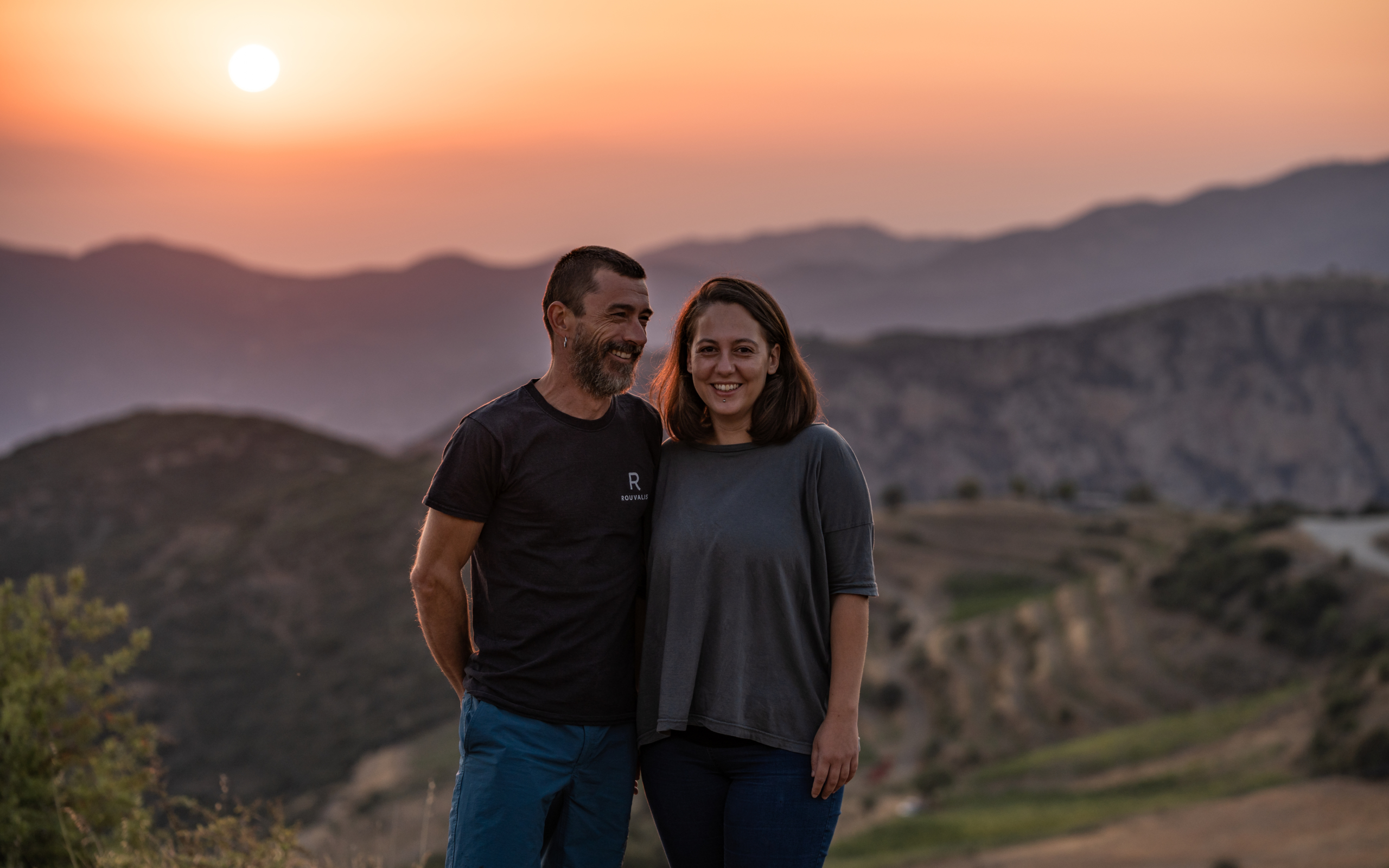
Throughout this period, Theodora Rouvalis gathers knowledge and experience in many wine regions around the world, on her own initiative. When she returns to Aigialeia and to the winery, she masterfully preserves the strengths of Angelos while reorganizing everything else. The Rouvalis family knows well that tradition consists of the innovations of the past, and that today’s innovations will either become part of tradition—if they are worthy—or be forgotten as unnecessary.
Theodora implements changes in the company’s organizational structure, shareholding, and Board of Directors, as well as in commercial strategy (distribution is now handled by W.S. Karoulias). She turns to the vineyard and proceeds with a complete renewal of the company’s products and labels. The shift toward premium wines is clear and supported by 12 ha of new privately owned vineyards at 1,000 meters altitude in Syracho (on the border of Kalavryta and Aigialeia), established with great effort as an initial response to the climate crisis. Organic cultivation takes the lead in the vineyard, while in the cellar Antonio applies biodynamic principles, drawing from his extensive experience as an oenologist in a biodynamic Burgundy winery. The team is joined by Yiannis Vagenas, a specialized wine‑market professional with studies in Tourism, Business Administration, and Human Resources.
In the Vineyard
Theodora and Antonio pioneer very dense plantings (6500-7000 vines per ha), encouraging the vines to deepen their root systems. They support the barren mountainous soils with organic bio‑fertilizer and vetch sowing (green manure), while keeping yields very low so the vines can withstand harsh climatic conditions.
In collaboration with Bakasietas Nurseries, they test seven different clones of the pink‑skinned Roditis, advancing research on the variety, while also promoting late‑ripening Greek varieties such as Mavrodaphne, Roditis, Kydonitsa, Assyrtiko, and Lagorthi. Regarding Lagorthi, they select the old representative biotype and propagate it.
Two meteorological stations, installed in collaboration with the University of Patras, measure numerous parameters in two different vineyard sites. Winter waters, abundant in the mountains, manage to fill the reservoirs they constructed to support young vines in summer, when water supply is abruptly cut.
In the Cellar
Correspondingly, new priorities are steadily integrated into the winery: lower alcohol levels, lighter bottles where possible, recycling of packaging materials, use of grape pomace to create organic fertilizers for reuse in the vineyards, distillation of wine lees, production of organic wines, and of course, faithful expression of terroir authenticity and the varieties that shape each year’s wines. The winery is designated as visitable and participates consistently in the Oinoxeneia festival founded by Angelos in 2013.
Meanwhile, Theodora and Antonio continue to study new products when they have something innovative to express in terms of flavor and culture. The label “Tzivieres,” a sweet wine from the Kydonitsa variety, is presented for the first time after years of plantings and trials. It is a sun‑dried wine that once contributed to the historic Malvasia wine of Laconia. Its primary aroma, the charming astringency of quince, and the balanced interplay of sugar and alcohol offer new dimensions of pleasure to the modern wine lover.
The Future
The Rouvalis family creates and adds value both to the land of Aigialeia and to Greek wine as a whole. The struggle for branded, high‑quality, authentic Greek wine never stops, as various forces continue to emerge—those who succumb to temporary marketing trends, those who flatten everything to sameness, those who seek easy profit from imported bulk wine, and those who are discouraged by the real difficulties faced by growers, who experience firsthand the obstacles to the revival of agriculture and the magnificent Greek countryside. Equally discouraging is the fact that wine struggles to enter the restaurant sector with VAT at 24%, meaning one quarter of its price.
Ahead of the Challenges
The Greek vineyard has changed radically in recent years. The climate crisis is in full swing, and disruptions in the global market are constant. Greek wine needs to rise to the top of the global value scale. The Rouvalis winery is here to transcend challenges and to detect new opportunities with open antennas.